VTS

Build what your existing tools can’t do.

Velociteam Studios builds and connects applications, portals, and workflows around a specific business need. We can include practical AI when it improves the work, with clear review points for people.

Talk through your project
What an engagement can include

A specific need.
A considered solution.

Your team may be repeating manual work, moving information between disconnected systems, or asking customers to follow a confusing process. We assess the need, then implement the application, portal, integration, or focused AI capability that fits the agreed scope.

Custom applications

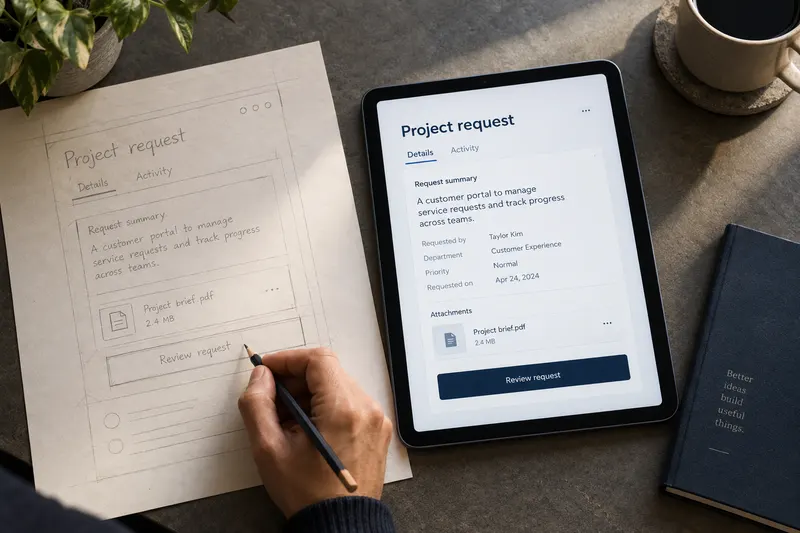
Paper interface sketch beside a tablet showing a matching application concept.

Build around the work your team actually does.

An internal tool or web application can bring requests, approvals, records, and repeated tasks into one clear workflow. We define the users and requirements, then design and build the agreed application.

  • Workflow and requirements definition
  • Interface design and prototyping
  • Application development
  • Testing with representative tasks

Customer and team portals

Give people one place to take action.

A portal can give customers, partners, or staff a shared place to submit requests, exchange documents, and see updates. Access and features are designed around each user’s role and the information they need.

  • Sign-in and role-based access
  • Request and status tracking
  • Document exchange
  • User journeys and access-rule testing

Purpose-built integrations

Connect the systems behind the process.

When a supported connector cannot handle the required workflow, a custom integration may close the gap. We assess platform access, data movement, and limitations before agreeing what to implement.

  • API and platform-access review
  • Data ownership and field mapping
  • Validation and exception handling
  • Testing, documentation, and handover

AI assistants and automation

Use AI for a defined job with human review.

A scoped application can include an internal knowledge assistant, document processing, or an AI agent that carries out a defined task with appropriate access and approval. We test outputs against real examples and define where a person reviews, corrects, or approves the result.

  • Knowledge assistants and focused prototypes
  • Information access and data-use requirements
  • Task agents, output evaluation, and human review
  • Integration into the agreed workflow
How we work

From a defined need
to a working application.

We define a useful first version, design and build it, then test it with realistic tasks. Documentation, team guidance, and any ongoing help are agreed for the project.

  1. Define the work

    Map the users, the process, and the information involved. Agree what the first version needs to do.

  2. Design and build

    Prototype uncertain parts, review the experience, and implement the agreed application and connections.

  3. Test and launch

    Check the main tasks, access rules, and failure cases. Evaluate any AI outputs, then put the work into use with your team.

  4. Keep improving

    Hand over the documented application, or continue with maintenance, monitoring, and improvements within an agreed ongoing scope.

Custom is an option, not the default.

If the answer is a better setup or a connection between existing tools, we can start there.

Explore Business Systems
Before we start

A few practical
questions.

You don’t need to choose the technology before we talk.

Do we need a custom build?

Not always. Configuring an existing tool or adding a supported connection may be enough. We compare those options against the requirement and the work involved in building and maintaining something custom.

Can we start with an idea rather than a specification?

Yes. Bring the process, the problem, or the idea. We can help define the users, the first useful version, and the questions a prototype should answer.

Does every project need AI?

No. AI is one possible approach. A straightforward application, a better workflow, or a conventional integration may be a better fit. If AI is useful, we agree how outputs will be checked and when a person takes over.

What happens after the build?

We agree on the documentation, access, and guidance needed to hand the application to your team or another provider. You can also engage us for maintenance, monitoring, and improvements. Hosting, third-party services, and support responsibilities are defined for the engagement.